A Mass Exit from the Registry
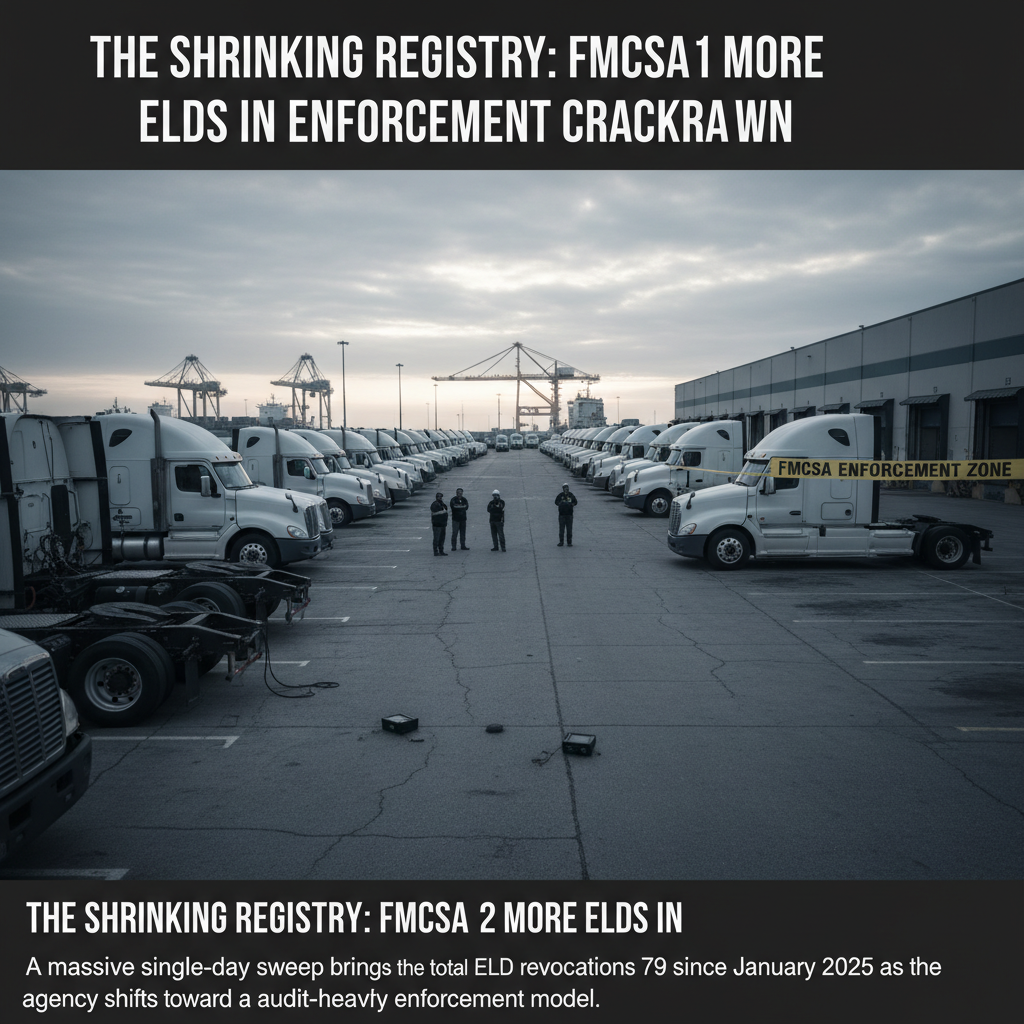
The Federal Motor Carrier Safety Administration (FMCSA) is fundamentally reshaping the electronic logging device (ELD) market through a strategy of aggressive attrition. In a single day, the agency announced the removal of 12 devices from its registered list, markinng the largest mass revocation since May 2025.
According to data first reported by FreightWaves, this latest sweep brings the total number of revoked ELDs to 79 since January 2025. The pace of enforcement has accelerated significantly; while the average over the last 16 months hovered around four removals per month, the agency is now trending toward five.
The 12 devices recently barred failed to meet technical specifications outlined in federal law (49 CFR Appendix A to Subpart B of Part 395). The list of newly non-compliant hardware includes:
- 888 ELD (MAUMAU LLC)
- Dragon ELD
- Action ELD
- Mondo ELD HOS (Mondotracking Solutions)
- First ELD (Two versions; First ELD LLC)
- MTL ELD and USPower ELD (Power ELD LLC)
- Sam Freight ELD (Sam Freight Management LLC)
- DSGELOGS (DSG Tracking LLC)
- Cobra ELD (Cobra Connect LLC)
- GT USA ELOGS (GT ELD)
The High Cost of Self-Certification
The current ELD ecosystem relies on a "self-certification" model. Manufacturers "grade their own homework," submitting paperwork to the FMCSA stating their hardware meets federal standards. The agency then adds the device to a public registry.
The flaw in this system is now coming to light: carriers often purchase these devices under the assumption that federal registration equals federal approval. It does not. When the FMCSA eventually audits these devices and finds them lacking, the financial and operational burden falls entirely on the motor carrier, not the manufacturer that has already collected its fees.
FMCSA Administrator Derek Barrs emphasized that the agency is no longer willing to tolerate the lag between registration and realization. "Safety is not optional, and neither is compliance," Barrs stated, signaling that the "cleanup" of the registered list is an operational priority.
Market Consolidation by Attrition
While there are approximately 1,050 devices remaining on the registry, the inflow of new participants has stalled. The market is witnessing a de facto quality filter: the registry is shrinking as the "bottom of the market"—low-cost providers with minimal engineering infrastructure—is purged.
If the current trajectory holds, the U.S. market may functionally mirror the Canadian model, which require third-party certification before a device can hit the road. While the U.S. has not legally shifted to third-party testing, the FMCSA’s aggressive post-market audits are achieving the same result—a smaller pool of vetted, reliable vendors.
Practical Implications for Industry Stakeholders
For carriers, brokers, and shippers, the current regulatory climate demands a shift from passive compliance to active vendor risk management.
For Motor Carriers:
- The 60-Day Clock: Carriers using any of the 12 revoked devices must immediately revert to paper logs and have until July 20, 2026, to install a compliant replacement.
- Vetting Vendors: Do not assume a device is "safe" just because it appears on the FMCSA registry. Verify the manufacturer’s history, software update frequency, and whether they have a physical support presence in the U.S.
- Out-of-Service Risk: After the 60-day grace period, drivers using revoked devices will be cited and placed out of service. This results in immediate freight delays and hits to the carrier's Safety Measurement System (SMS) scores.
For Shippers and Brokers:
- Capacity Volatility: Frequent mass revocations can lead to sudden capacity crunches as small fleets are sidelined while waiting for new hardware.
- Due Diligence: Logistics providers should integrate ELD monitoring into their carrier vetting processes. A carrier running on a recently revoked device is a high-risk asset for a high-value load.
"The enforcement model produces the same result as the certification model. It just distributes the pain differently. The pain falls on the people who had the least information." — FreightWaves analysis.
The era of "set it and forget it" ELD compliance is over. As the FMCSA continues to prune the registry, the industry must prepare for a more consolidated, more expensive, but ultimately more reliable electronic logging landscape.